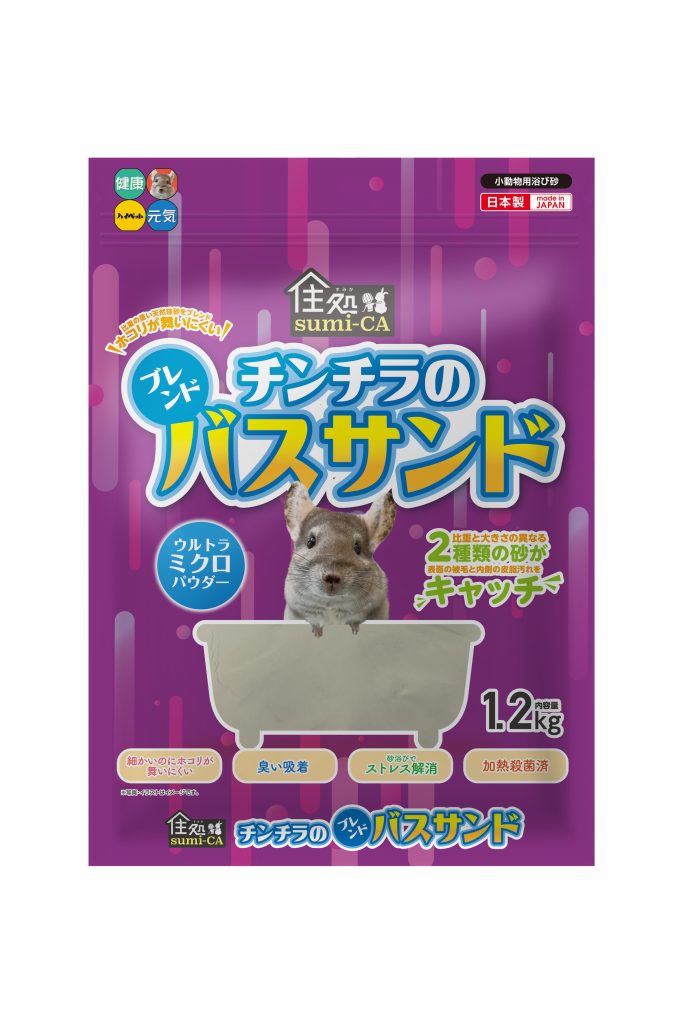










Wild chinchillas live in high-altitude, dry, rocky areas and cliffs. In this environment, they have a natural habit of using fine sand, such as volcanic ash, to remove dirt and excess oils from their bodies.
Pet chinchillas retain this natural behavior, so providing an environment where they can take sand baths helps maintain their health.

◆Maintaining Healthy Fur and Skin
Wild chinchillas live in environments without bodies of water, so they do not have a natural habit of taking water baths.
Their fur is extremely dense, with about 50 fine hairs growing from a single follicle, giving them a soft and fluffy coat.
Chinchillas secrete a substance called lanolin from their sebaceous glands to maintain the health of their skin and fur. If excess secretion is not removed, it can lead to dirt buildup in the hair follicles and on the skin.
Sand baths act like a “dry bath,” helping to remove dirt and excess oils from the fur.
Additionally, chinchillas have a two-layered structure—hard outer hairs (guard hairs) and soft, dense underfur—to adapt to harsh environments with large temperature fluctuations and dryness. This structure makes them sensitive to humidity, and damp environments can promote mold and bacterial growth.
Sand baths improve air circulation to the skin, helping prevent trapped moisture and maintain healthy fur.
◆Stress Relief and Instinctual Needs
Wild chinchillas naturally dig and create burrows to rest during the day, so they instinctively enjoy digging and rolling behaviors.
Digging in sand and rubbing their bodies in it not only keeps their fur clean but also helps relieve stress and satisfy their natural instincts.

For chinchillas, which have a two-layered structure with dense, fine fur, the ideal sand is an ultra-fine powder type that can reach the base of the hairs.
Coarser sand may not penetrate to the hair roots, making it difficult to remove internal oils and dirt effectively.